Physical Address
304 North Cardinal St.
Dorchester Center, MA 02124
Physical Address
304 North Cardinal St.
Dorchester Center, MA 02124

France : Immigration, Asile et Opportunités d'Emploi
France : Immigration, Asile et Opportunités d'Emploi
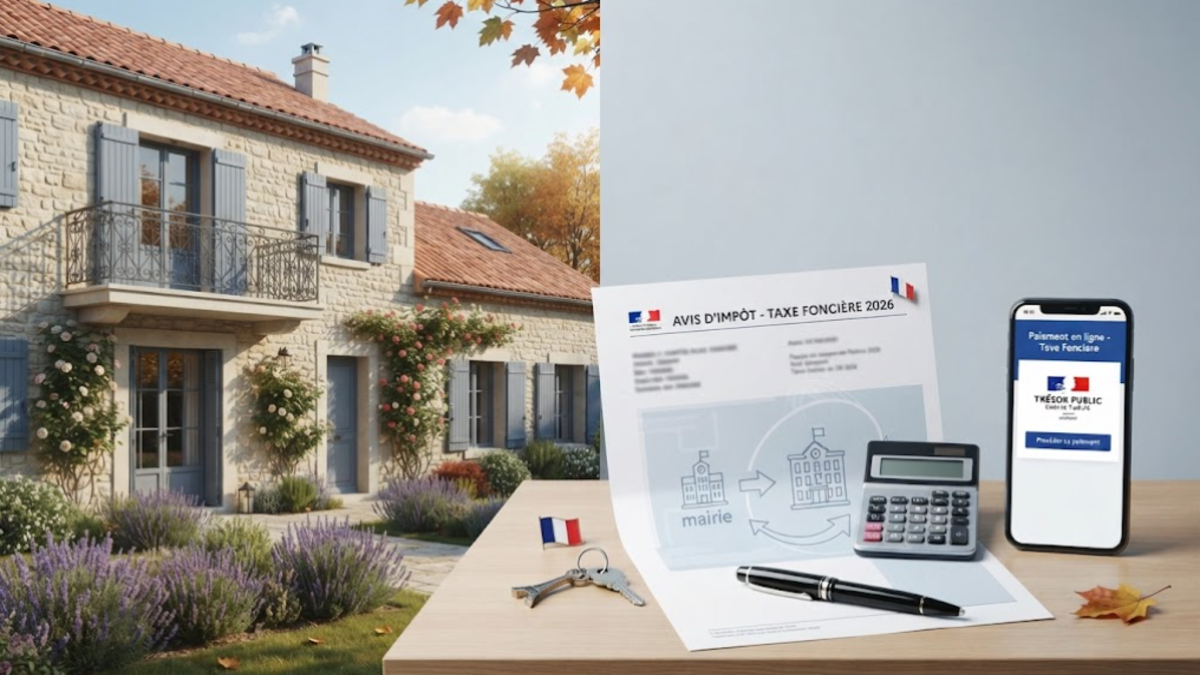
The 2026 French property tax bill is now available to taxpayers according to their payment arrangements. For non-monthly taxpayers, notices were made available online from 27 August, while monthly taxpayers can access theirs from 19 September. The payment deadline is 15 October for non-digital payment methods and 20 October at midnight for online payment.

The amount varies from one property to another because it depends both on the property’s cadastral rental value and on the local tax rates. This year’s cadastral revaluation coefficient is 1.008, meaning a 0.8% increase in the calculation base for the relevant built and non-built properties, before the effect of local rates and any other changes affecting the property.
For owners who believe their assessment is incorrect, French tax authorities provide a formal complaints procedure, including online submission through the secure messaging service on impots.gouv.fr.

The property tax on built properties (taxe foncière sur les propriétés bâties, or TFPB) is generally payable by the owner or usufructuary of taxable property. Exemptions and reliefs can apply depending on the property and, in certain circumstances, the taxpayer’s personal and income situation.
The tax is based on the property’s situation for tax purposes and is collected for the benefit of local authorities. The assessment can also include related charges, most notably the household waste collection tax (TEOM) where applicable.
There is no single national amount that applies to all homeowners.
The basic calculation combines the property’s cadastral rental value with the tax rates voted by the relevant local authorities. The cadastral rental value represents the theoretical annual rent that the property could generate under normal rental conditions.
For built property, the taxable base is generally obtained after a 50% allowance applied to the cadastral rental value. This allowance is intended to take account, on a flat-rate basis, of costs such as maintenance, insurance, depreciation and repairs.
The resulting amount is then subject to the applicable local rates.
A higher property tax bill does not necessarily mean that the local tax rate has increased.
Several factors can affect the final amount:
For 2026, the official tax administration states that the annual revaluation coefficient is 1.008, corresponding to a 0.8% increase in the relevant cadastral tax bases. The actual change in a taxpayer’s bill can nevertheless be different because local rates and the property’s circumstances also matter.
| Element | Role in the calculation |
|---|---|
| Cadastral rental value | Provides the property’s tax base |
| Applicable allowances | Reduce the taxable base where provided for |
| Local tax rates | Determine the tax due on the taxable base |
| Annual revaluation | Changes the cadastral base |
| TEOM, where applicable | Appears as a separate component on the property-tax notice |
The 0.8% revaluation should therefore not be interpreted as a universal 0.8% increase in every taxpayer’s final bill.
For 2026, the official deadlines are:
| Payment method | Deadline |
|---|---|
| Payment not made through an online method | 15 October 2026 |
| Online payment via internet, smartphone or tablet | 20 October 2026 at midnight |
| Monthly direct debit | According to the monthly payment schedule |
The exact deadline shown on the tax notice takes precedence in cases where the notice is issued later than the normal schedule.
Online payment is made through the taxpayer’s personal Finances account on impots.gouv.fr. For online payments made by the 20 October deadline, the bank debit is scheduled from 26 October, according to the tax administration.
Taxpayers who are unable to pay on time can also request an exceptional payment arrangement. The request can be made through the secure messaging service in their Finances account or through their public finance centre. The administration assesses such requests individually.
Before paying, it is useful to check the main figures on the notice rather than looking only at the total amount.
In particular, check:
The tax administration explains that the information concerning the calculation and applicable rates appears on the property-tax notice.
A significant increase should therefore be analysed by looking at the different components of the assessment. Comparing only the final total can hide the reason for the change.
If you believe there is an error in your property tax assessment, you can submit a formal complaint to the tax administration.
The simplest route for individuals is generally the secure messaging service in the Finances publiques account:
Finances publiques → Secure messaging → Write → Complaint/Challenge → Select the relevant tax and year.
Supporting documents can be attached to the online complaint. The administration then communicates its response through the taxpayer’s secure messaging system.
A complaint can also be submitted in writing to the competent public finance centre. The request should identify the taxpayer, the tax concerned, the reason for the challenge and the supporting evidence.
A complaint is appropriate when you believe there is an error in the calculation or amount of tax assessed. The supporting documents should therefore relate directly to the point being challenged.
Depending on the circumstances, the issue could concern, for example:
The tax administration distinguishes a tax complaint from a request for a payment extension. If the amount is correct but the taxpayer cannot pay it on time, the appropriate procedure is to request payment assistance rather than challenge the assessment itself.
For local taxes including property tax, the general deadline for a complaint is 31 December of the year following the year in which the tax was put into collection.
For an assessment put into collection in 2026, this means that the general complaint deadline is 31 December 2027, subject to any special rule applicable to the particular dispute.
It is better not to wait until the final weeks of the deadline. The taxpayer should keep the notice, supporting documents and evidence of the complaint.
Submitting a complaint does not automatically suspend payment.
The tax administration states that taxpayers normally remain required to pay the tax by the legal deadline. However, a taxpayer can request a sursis de paiement, meaning that payment of the disputed amount is deferred while the complaint is examined.
Specific guarantees may be requested in certain cases, including when the disputed amount reaches €4,500. If the complaint is rejected and the tax has not been paid, the administration indicates that the amount due may be accompanied by the applicable 10% late-payment surcharge.
This makes it important to distinguish between simply sending a complaint and formally requesting a suspension of payment.
A practical review can follow four steps:
First, compare the current notice with the previous one. Look for changes in the taxable base and rates.
Second, check the property information. Certain alterations, such as an extension, a new dependency or a change in the property’s characteristics, can affect the tax assessment.
Third, separate the tax components. The total shown on the notice can include the property tax itself as well as the TEOM and other applicable amounts.
Finally, contact the tax administration if an error remains apparent. The secure messaging service allows taxpayers to ask questions and file complaints online.
The most useful way to read a property tax bill is not to focus solely on the final amount. The 2026 revaluation of 0.8% affects the tax base, but the final bill also reflects local rates and the individual characteristics of the property.
For homeowners facing a higher bill, checking the detailed calculation before assuming that the increase comes from a single national measure can help identify whether the change results from the annual revaluation, local taxation decisions, a change in the property or another component of the assessment.
Where there is a genuine error, the official complaint procedure provides a clear route for asking the administration to review the assessment. Where there is no dispute but a payment problem, a payment-extension request is the relevant procedure instead.
There is no single percentage increase for every taxpayer. The official 2026 coefficient for the relevant cadastral rental values is 1.008, or 0.8%, but the final amount also depends on local tax rates and the individual property.
The standard deadline is 15 October 2026 for payment methods other than online payment. For online payment through the internet, smartphone or tablet, the deadline is 20 October 2026 at midnight.
You can file a complaint through the secure messaging service in your Finances account on impots.gouv.fr. You can select the relevant tax and year and attach supporting documents.
The general deadline for local-tax complaints is 31 December of the year following the year in which the tax was put into collection. For a 2026 assessment, the general deadline is therefore 31 December 2027.
Yes. A taxpayer experiencing payment difficulties can request an exceptional payment arrangement through the secure messaging service or from the relevant public finance centre. The request is assessed individually.