Physical Address
304 North Cardinal St.
Dorchester Center, MA 02124
Physical Address
304 North Cardinal St.
Dorchester Center, MA 02124

France : Immigration, Asile et Opportunités d'Emploi
France : Immigration, Asile et Opportunités d'Emploi
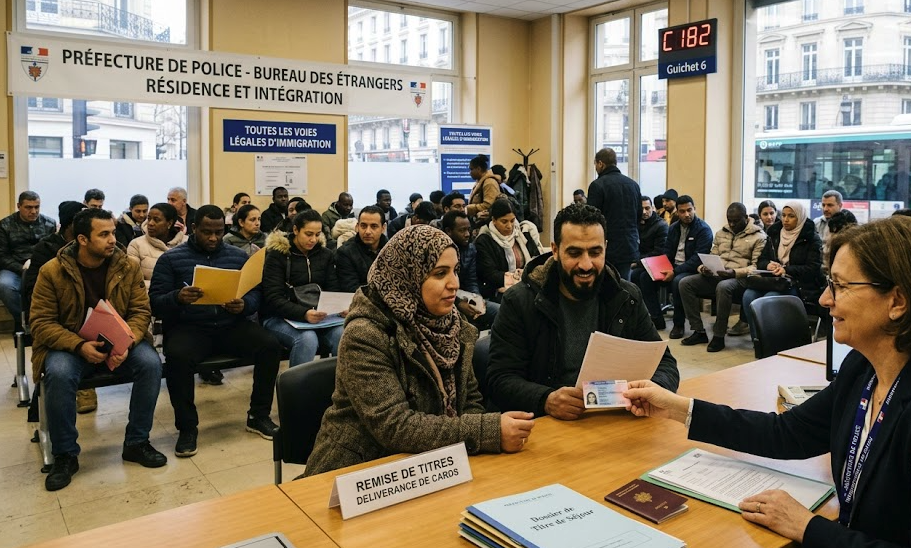
Paris – Franist: The query regarding how to obtain official residency—or specifically, the structural framework for the regularization of immigrants in France—remains one of the most widely discussed topics among individuals seeking a stable legal status within the European Union. In reality, there is no singular shortcut to achieving residency; instead, France offers a precise matrix of legal channels that vary significantly based on processing timelines, prerequisites, and long-term outcomes. While some pathways rely heavily on professional employment, others are rooted in family ties, higher education, or humanitarian grounds. Yet, a fundamental question persists among prospective applicants: which specific path is truly the fastest under practical administrative scrutiny rather than just on paper? This comprehensive investigation dissects the legal mechanisms in detail.

Securing legal residency in France means obtaining an official permit (titre de séjour) issued by competent state authorities, allowing a foreign national to live and function within the country legally for a temporary, multi-year, or permanent period.
These administrative procedures are governed strictly by state institutions, principally the local Prefectures (Préfecture de Police) and the French Ministry of the Interior (Ministère de l’Intérieur). The category of residency granted is directly dependent on the applicant’s primary purpose of stay and their dynamic compliance with national immigration codes.

Securing a residence permit through employment is highly transparent but remains subject to rigorous labor market protections.
The structural process requires:
A formal, verified employment contract from a company registered and operating in France.
An official work authorization (autorisation de travail) cleared by the relevant labor authorities.
Transitioning the initial visa into a renewable work residence permit (carte de séjour salarié).
The Practical Reality: Obtaining a direct contract from outside French territory is highly challenging. French employers must legally demonstrate that the position could not be filled by a local citizen or an existing EU/EEA resident before sponsoring a third-country national, making this route highly selective.
Asylum is a delicate international legal mechanism rather than a standard economic migration channel. It is strictly reserved for individuals who can provide substantive, credible evidence of a well-founded fear of persecution, systemic discrimination, or severe threats to their lives or liberty in their native countries.
Key Administrative Factors:
Applications are thoroughly processed and evaluated by the French Office for the Protection of Refugees and Stateless Persons (OFPRA).
Every dossier undergoes deep, individualized judicial scrutiny to ensure validity.
Waiting periods are highly variable and can extend across long periods, during which applicants hold a temporary asylum seeker status.
This stream is designed to maintain structural family units and stands as one of the most stable long-term residency tracks available.
The core legal criteria include:
The sponsoring relative must hold a stable, legal residence status in France.
The sponsor must demonstrate regular, sufficient financial income to support the dependents without state aid.
The family must occupy a residential dwelling that satisfies national standards of space and safety.
Entering into a legal marital union with a French national opens an official path to legal residency, though it is subject to rigorous anti-fraud measures.
Critical Procedural Points:
The state conducts thorough background checks and personal interviews to verify the authenticity of the union.
Continuous cohabitation and shared material life must be strictly proven over several years.
Regular follow-ups are implemented by administrative offices to completely eliminate marriages of convenience.
Higher education offers a structured entryway for global students to reside in France temporarily for the duration of their academic curriculum.
The Long-Term Outlook: While a student visa provides immediate legal entry, it does not guarantee permanent residence. Following graduation, individuals must successfully transition their status by finding a qualified professional position or securing an official corporate contract that aligns with their academic specialization.
When analyzing the actual operational flow of French prefectures, the velocity of an application is heavily determined by the structural clarity of the file. Generally, genuine marital unions and fully compliant family reunification dossiers experience the most predictable and swiftest processing tracks.
Conversely, economic employment permits initiated from abroad face extensive administrative checks regarding local labor market impacts, and asylum requests are subject to rigorous individual verification scales, rendering their timelines entirely unique to each specific case.
| Pathway Category | Processing Velocity | Difficulty Level | Long-Term Stability |
| Employment (Salarié) | Moderate | Elevated | High |
| Asylum Protection | Variable | Highly Scrutinized | Unguaranteed |
| Marriage to a Citizen | Relatively Swift | Moderate | High |
| Family Reunification | Moderate | Low (If compliant) | High |
| Higher Education (Student) | Moderate | Moderate | Temporary |
The structural framework governing the regularization of immigrants in France is undergoing significant modifications as the federal government balances humanitarian commitments with domestic labor market absorption capacities. Historically, France has relied on predictable economic immigration draws to maintain demographic equilibrium; however, changing global dynamics and domestic pressures have forced immigration authorities to reassess their annual intake targets. For prospective applicants, this means that tracking policy shifts in real-time is no longer optional, but a fundamental requirement for a successful application.
According to recent policy updates analyzed by the editorial team at Franist, authorities are shifting their focus toward highly skilled « in-country » candidates. This strategy aims to prioritize individuals who are already residing within French borders on temporary permits—such as international graduates and specialized technical workers—thereby reducing the immediate strain on social infrastructure while filling critical vacancies in healthcare, technology, and engineering trades. Consequently, individuals hoping to achieve permanent status from abroad must optimize their profiles to remain competitive within the selection pool.
Furthermore, integration has emerged as a dominant trend in contemporary French immigration strategy. The state is increasingly leveraging specific requirements to ensure newcomers blend directly into local communities facing demographic declines. These pathways often feature strict evaluation scores regarding income levels or alternative benchmarks compared to old mainstream programs, offering a highly specialized framework for applicants. Understanding these systemic distinctions can significantly reduce processing timelines and increase approval probabilities.
Looking ahead, the long-term viability of securing status in France will depend heavily on an applicant’s adaptability to evolving selection systems and profession-specific regulations. The implementation of stricter language and integration thresholds means that having a basic job offer is occasionally secondary to possessing targeted experience in a highly skilled, in-demand profession. Therefore, navigating this landscape requires a strategic evaluation of one’s professional trajectory, language capabilities, and financial readiness, proving that a successful immigration journey is built on meticulous, long-term planning rather than short-term procedural shortcuts.
What is the most stable way to secure a permit in France?
While individual situations dictate the outcome, family reunification and marriage channels statistically offer the most direct pathways to long-term stability, provided all standard legal conditions are fully satisfied.
Is it possible to obtain residency without a corporate work contract?
Yes. Foreign nationals can achieve valid legal status through alternative channels such as specialized higher education tracks, marriage, family sponsorship, or approved international protection claims.
How long does the asylum review process take in France?
There is no fixed timeline. The processing duration varies substantially based on the volume of applications handled by OFPRA and the specific complexities involved in validating the individual’s claim.
Does graduating from a French university grant permanent status?
No. An international student visa is inherently temporary. To achieve permanent residency, a graduate must successfully transition into the active workforce by securing a professional position that complies with national immigration criteria.
Ultimately, the true impact of the regularization of immigrants in France is not defined by a generic timeline, but by the thorough alignment of an individual’s personal background with the strict, evolving administrative requirements mandated by the French state…..Lire la suite
Contact : info@francealyom.com